Tuesday, May 5, 2015

Art in the Gardens at Edison Estates: Flowers


The 7th Annual Art in the Gardens returns to the Edison and Ford Winter Estates from April 12 - May 15, 2015. The theme this year is “Flowers in the Garden"  Each art piece must be made with recycled materials, and the artwork must be sturdy enough to withstand Florida weather. More than 20 Lee County Schools have their artwork on display for visitors to enjoy in the Heritage Garden. The student installations of garden art are incorporated into a background of flowers, plants and trees which are a permanent part of the truck garden. There is also a large collection of plants for sale, including butterfly garden plants. On the day I visited the garden, there were countless butterflies flitting around the area--more than I’ve ever seen flying around without being in an enclosure, drawn by the plants in bloom.


This year I think that the artwork exhibits done by the elementary school students outshone their older counterparts. The younger students came up with fun, creative, whimsical designs; while the exhibits of older students were more polished and professional-looking, they didn’t have the playfulness that the elementary students’ artwork displayed. But keep looking, and judge for yourself.


The Opening Reception for the exhibit was on April 12.


Fan-paddle flowers by Pine Island Elementary


Art teacher Gloria Van Duzer


A huge CD-flower behind Mina Edison
 
 
The flower made of many, many compact disks is by South Fort Myers High.
 

Art teachers Jeanne Dozier and Tina Miller
 
 
Maypole with streamers by Varsity Lakes Middle School.
 On a windy day, the streamers got tangled up, or the effect would have been prettier.
 
 
Art teacher Marjorie Resler
 
 
Hubcap flowers by Lehigh Senior High

 
Art teacher Betsy H

 
Roses, LED light bulb flowers and mop-head flowers

 
Tribute to Mina and Hilda, A Swynnerton Rose


A rose garden in Staffordshire, England, commemorates the “Swynnerton Roses,” women who worked in an ammunition factory during World War II--a very dangerous job at the time because of the explosive ingredients of the munitions, such as TNT, and of bombing raids targeting the factory. (That’s all I learned about these roses. I’m not sure if this reference is correct, but it is an interesting story, anyway.)


A Swynnerton Rose by Cypress Lake High School Center for the Arts


LED light bulbs make up the center of the flower by St Andrew Catholic School.


Art teacher Diana Villadolid


A cluster of flowers by Edison Park Creative and Expressive Arts School

 
Art teacher Karen Flanders
 
 
One of the flowers in the cluster
 
 
Mop-head flowers by Estero High
Art teacher James Milne


A yarn flower and flowers in pails in front of real garden plants
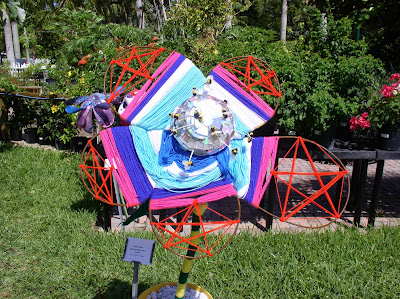
 
A yarn flower with a unique center, well-liked by bees, by Bayshore Elementary

 
Art teacher James Lefko
 
 
Flowers in pails by Trafalgar Elementary
 
 
Art teacher Helen Garcia-Valdez
 
 
A tall red rose by Trafalgar Middle School
 
 
The rose and bud
 
 
Art teacher Margaret Horn
 

A bird and flower-covered house by Challenger Middle School
Art teacher Sandy Rayannic

 
Clematis Florida Sieboldii cluster by Fort Myers High


Art teacher Crystina Castiglione


A single rose by Mariner High
Art teacher Jen Riley


Colorful day lilies by Mirror Lakes Elementary


Art teacher Angela Weiss


Bottle-top flowers by Rayma C. Page Elementary


Art teacher Robert Sherry
 
 
Bottle-top flower construction from side
 
 
Pie-plate flowers by Tice Elementary
 
 
Art teacher Jill Kessler

 
Wild Flowers from plastic glasses by Tortuga Preserve Elementary

 
Zebra Flowers

 
Art teacher Christina Sterrett

 
Giant plastic utensil flowers by Veterans Park Academy for the Arts
 
 
Art teacher Jill Antonucci
 
 
Mosaic urn by St Francis Xavier Catholic School
 
 
Art teacher Vanessa Lombardo
 

Butterfly Garden plants
 
 
Butterfly perched on Lantana
 
 
Another butterfly on Ixora
 
 
Reflecting pool in the Heritage Garden
 

The reflecting pool up close


Wednesday, January 28, 2015

Art with Lego Bricks at the Naples Botanical Garden

Exhibit: Nature Connects 


The “Nature Connects” exhibit at the Naples Botanical Garden ran from February 14 to May 11, 2014. The show featured displays built with LEGO bricks by New York artist Sean Kenney. All of the larger-than-life sculptures are inspired by nature and represent the network that interconnects all living things. The “Nature Connects” exhibit is currently touring the country and has been featured in botanical gardens and zoos since 2012 and will continue through 2016. 

Kenney had a career as a cartoonist, graphic artist and website developer before he decided to do what he loved, building beauty with LEGO bricks. Today, Sean has become an elite LEGO builder, and with his team designs and creates contemporary sculpture for clients, corporations and venues worldwide.

The sculptures are located all over the Naples Garden, and it takes some determination to find them all because the themed gardens are spread over a wide area. The gardens are lovely, and each time I go to the Naples Garden, there is something different to see. Most recently, new structures include a new visitor center and an orchid house. However, when you are searching for specific LEGO sculptures which are at one with nature, you need to be observant, and in some cases do some detective work to find them, kind of like a treasure hunt. Fortunately, a list of the sculptures was provided, along with the garden in which they were located.


THE CHILDREN’S GARDEN

Tiger Swallowtail Butterfly

The first large sculpture you see in the garden is an in-flight Tiger Swallowtail butterfly. The sculpture is over 5 feet across, was built with 37,481 LEGO pieces and  took over 250 hours to design and build. Fittingly, the butterfly is in front of the glass butterfly house in the background.


Tiger Swallowtail Butterfly


American Bumblebee 

The bumblebee is suspended from the ceiling of the fort. It is over 4 feet long and has a 6-foot wingspan. The sculpture contains 16,383 LEGO pieces and took 4 weeks and 160 hours to design, build and glue. By some stroke of luck, the bee was perfectly balanced when he was hoisted into place. The little kids on the left have an eye-level view of the bee.


American Bumblebee


American Bumblebee


Gardener

This life-size gardener was built with 37,497 LEGO pieces and is over 6 feet tall and took 300 hours to design and build. Each piece is glued one-by-one, and a steel armature helps keep the sculpture secured to the ground.


Gardener


Gardener


Goldfinches

These life-size American Goldfinches are each about 6 inches long and are mounted to a real bird feeder. They were designed with multiple postures and set up to look as realistically posed as possible. Naturally, LEGO birds eat LEGO pieces from the bird feeder. 


Goldfinches


FOX

This giant sculpture of a fox is nearly 6 feet long and contains 17,547 LEGO pieces. He took over 200 hours to design and build. He is about to pounce on the poor little rabbit. 


RABBIT

This giant rabbit is nearly 2 feet long and contains 1,361 LEGO pieces. He was built together with a fox, cunningly stalking the poor little fellow. The sculpture took over 20 hours to design, build, and glue to a steel base in order to fasten the sculpture to the ground onsite.


BRAZILIAN GARDEN PAVILION

Victoria Water Lily Pads

This scene, installed in the top level of the Brazilian Garden waterfall, is built entirely out of 57,132 LEGO bricks and features five giant lily pads, a frog and a water lily (lotus bloom). The lily pads are 5 feet across each -- which is how large these plants actually grow, and each contains 10,598 LEGO pieces (52,990 total). Each lily pad took over 60 hours to build and are glued to a steel armature to keep the sculpture elevated above water level. 


Frog on Lily Pads

This cute little frog is life-sized, was built with 530 pieces and  installed on one of the giant lily pads.


ASIAN GARDEN


A Thai Pavilion in the Asian Garden


Jumping Koi

This Koi fish, installed in a pond, is built out of 1,937 LEGO bricks.

Jumping Koi


“Trinity Root Maquette," 2003, cast bronze by Steve Tobin, 
on loan from the Baker Museum, Artis-Naples

In 2005, artist Steve Tobin created a ten-foot-tall bronze sculpture of a sycamore tree’s root structure for Trinity Episcopal Church on Wall Street. The sycamore in question is known as “the tree that saved St. Paul’s Chapel,” because it took the brunt of damage from debris falling from the World Trade Center on September 11, 2001, and the chapel remained relatively unscathed. (A maquette is a  model of the final sculpture.)


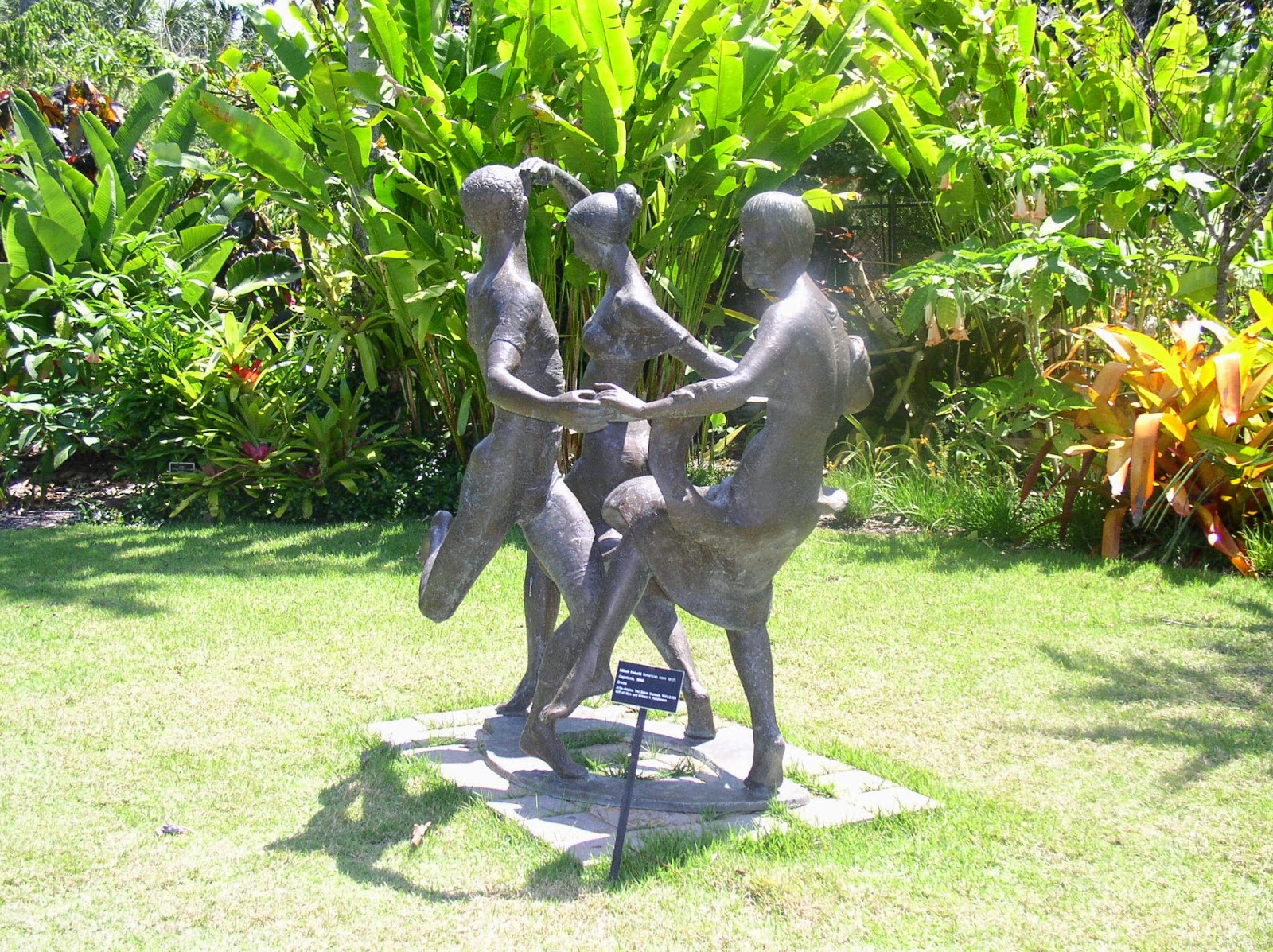
“Capriccio” 1986, bronze by Milton Hebald, 
on loan from the Baker Museum, Artis Naples


“Capriccio” means lively music.


CARIBBEAN GARDEN

Lawn Mower

This life-sized lawnmower contains 13,704 LEGO pieces and took 200 hours to design and build. It's designed as a "photo op" where visitors can walk up and grab the handle to take a photo. 


Lawnmower


Lawnmower


FLORIDA GARDEN

Bison and Calf

The life-sized Bison with a cowbird on its back is nearly 7 feet long and contains 45,143 LEGO pieces. It was built together with Baby Bison. The entire sculpture took 700 hours to build with a team of 6 model builders over the course of 6 weeks. Because this sculpture is installed outdoors, it needs to withstand the elements and overly curious visitors. Kenney’s team designed a steel skeleton to reinforce the structure which can additionally be bolted to the ground. 


Bison 


Bison Calf

This life-sized bison calf is nearly 4 feet long and contains 16,229 LEGO pieces. It was built together with Mama Bison. Baby was built over the course of 140 hours. A steel armature helps keep the sculpture secured to the ground.


Germinating Acorn

This is a sculpture of an acorn as it begins its life as an oak tree, with leaves and shoots unfurling and reaching for the sun. It's over 5 feet tall and was built with 15,581 pieces. The sculpture took over 200 hours to design and build. LEGO sculptures are very difficult when they are either thin or horizontal, and the leaves in this sculpture are thin AND horizontal!


Germinating Acorn


Hummingbird

This giant Ruby-Throated Hummingbird  hovers 8 feet in the air as it feeds out of giant flowers. The sculpture took over 550 hours to design and build: that is, over 4 weeks to design and 5 weeks to build with 31,565 LEGO pieces.  Kenney describes the process:

“The sculpture is so tall that we had to stand on stepladders to build it!  One day while we were up on top of ladders building the wings, one of my assistants walked by and laughed, "Wow, it's getting so tall! Any taller and it won't fit out the door!" Shocked, we stopped and measured… she was right! The hummingbird wings are so tall and so wide that they would not fit through a standard door. So we redesigned the wings so they could be removed on steel pins and re-inserted after going through a doorway.” Problem solved. I thought this sculpture was fascinating because the hummingbird seems to be hanging in mid-air without a visible means of support.


Hummingbird


Hummingbird


Rose

The sculpture is 7 feet tall and was built with 41,242 LEGO pieces. This elegant piece  was designed and built the way a real rose is built... every petal is there, unfurling out from the rose bud. This sculpture was so tall that the builders had to put tables on top of tables (and then step stools on top of that) in order to be high up enough to finish the uppermost layers. The stem is reinforced with a steel core so that this top-heavy sculpture can withstand high winds.


Rose


Rose


WATER GARDEN


Common Green Darter Dragonfly

This larger-than-life dragonfly has a 4-foot wingspan, contains 6,535 LEGO pieces and took 4 weeks to design, build, and glue. A steel frame elevates it above the marshland where it hovers along like a real dragonfly.


Dragonfly

For more information on Sean Kenney and LEGO-building, go to: www.seankenney.com